

Haman County in South Korea has opened a KRW1.567 billion emergency loan programme for winter-watermelon growers affected by viral disease in protected cultivation. The official government funding notice, posted on 17 November 2026, sets an application window from 16 to 25 November. It is a lending facility, not a grant allocation or a report of funds already disbursed.
The county reported damage at 41 farms across 24 hectares of winter-watermelon houses around Gunbuk-myeon and Wolchon-ri, according to News1’s 18 November reporting. The estimated damage was KRW780 million at that point. Those county-reported figures are an initial local assessment, not a verified final harvest loss.
Loans cover operating needs and greenhouse facilities
Eligible applicants are growers resident in Haman County whose winter-watermelon crops were affected by the outbreak. The official notice identifies two uses: operating finance, including materials needed for protected-house production, and capital for greenhouse structures and equipment. Applications must be submitted in person at the applicant’s local township or municipal office.
Regional reporting on the county announcement states that individual borrowers can seek up to KRW50 million for operating needs and separately up to KRW50 million for facilities. Reported repayment terms are one year of grace followed by three years of instalments for operating loans, and two years of grace followed by three years for facility loans. Borrower selection is expected on 30 November; selection and actual loan disbursement have not yet been confirmed.
Virus pressure threatens a concentrated winter crop
Haman’s winter-watermelon sector spans approximately 220 farms and 105 hectares and supplies about 70% of South Korea’s winter-watermelon production, according to county figures relayed in local reporting. The 24 hectares of reported damage must not be confused with the whole 105-hectare growing area.
The regional report identifies three viruses detected in local testing: cucurbit chlorotic yellows virus (CCYV), zucchini yellow mosaic virus (ZYMV) and watermelon mosaic virus (WMV). County officials linked increased pest-vector activity during unusually hot transplanting weather to the outbreak, but that attribution does not quantify the ultimate effect on yields or prices.
Why this matters for protected-crop businesses
For winter-watermelon growers, the programme offers a time-limited route to working capital and possible greenhouse repairs while crop health and cash flow are under pressure. For suppliers and produce buyers, the affected acreage and the county’s role in national winter supply are concrete exposure indicators—not evidence that nationwide shortages or price increases have occurred.
What remains unclear
The eventual number of approved borrowers, funds actually lent, full infected area, production losses and market effects remain unknown. Those measures, along with any county update after the 25 November deadline, are the next evidence to watch.
Key takeaways
- Haman’s KRW1.567 billion emergency response is a loan programme open for applications through 25 November, not a paid-out subsidy.
- The county reported 41 affected farms and 24 hectares of protected winter-watermelon crops, with damage initially estimated at KRW780 million.
- Loan take-up, final crop losses and any supply or price impact are not yet established.
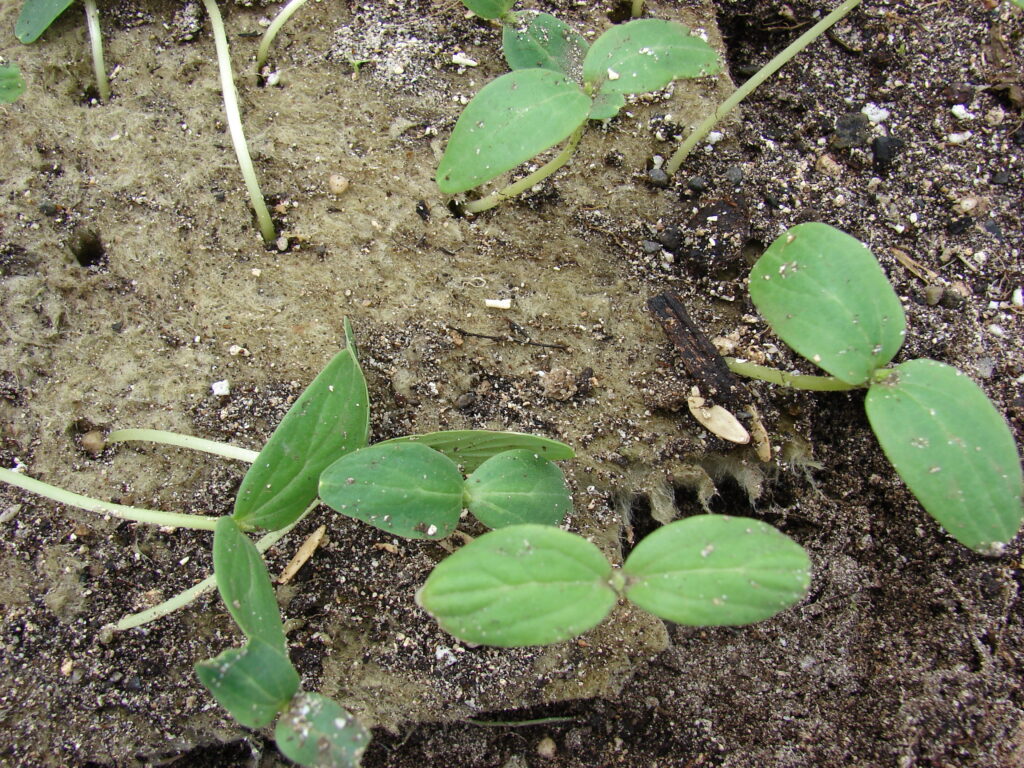
Featured image: historical illustration of watermelon seedlings growing in a greenhouse on Midway Atoll, Hawaii, in June 2008; it does not show affected Haman County farms, virus symptoms or the 2026 emergency response. Photo: Forest & Kim Starr / Wikimedia Commons, CC BY 3.0 US. Human decision on contextual suitability is pending.