

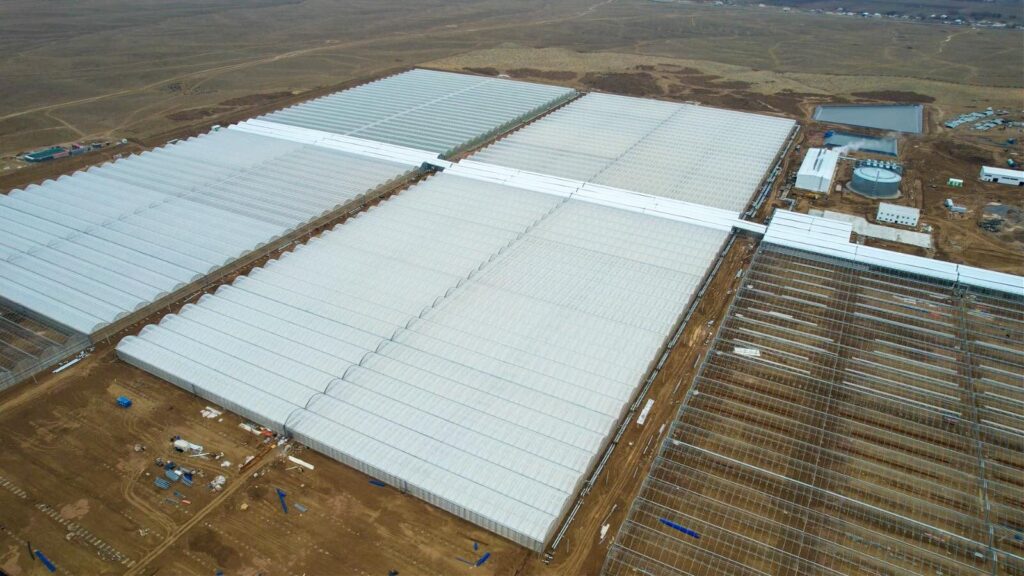
Kazakhstan’s Ministry of Agriculture says another 37.5 hectares of tomato greenhouses at the Ecoculture-Eurasia complex in Keles District, Turkestan Region, were brought into operation during autumn 2026. The ministry confirmed the commissioning in a 16 November update following a regional press visit.
This marks a change in project status: an 18 August ministry report had described the same 37.5 hectares as scheduled for commissioning later in the autumn. The November report says the first stage now covers more than 50 hectares in total.
From initial tomato harvest to expanded growing area
The ministry reports that the operation harvested 2,000 tonnes of tomatoes from 6.25 hectares in 2025. That historical production figure relates to an earlier cultivated area; it should not be read as harvest output from the additional 37.5 hectares commissioned this year.
The project’s reported investment is KZT 42 billion. This is the wider Ecoculture-Eurasia project figure, not the cost of commissioning the additional 37.5 hectares alone. The ministry describes the greenhouse operation as a partnership with Russian agricultural group EKO-kultura and says equipment sourced from the Netherlands is used to automate temperature, watering, lighting and crop nutrition.
What the 27,000-tonne figure means
In the November account, the ministry gives an annual production capacity of 27,000 tonnes of tomatoes for the first-stage complex. This is a stated capacity figure, not independently documented annual harvest from the newly commissioned area. The official account does not specify when the additional blocks produced their first commercial crop.
The same statement outlines a longer-term ambition to expand greenhouse area to 500 hectares and production to 240,000 tonnes a year by 2030. Those figures describe a future plan, not greenhouses already built or output already achieved.
Why the commissioning matters
For greenhouse suppliers, produce buyers and investors, the material development is the shift of 37.5 hectares from planned capacity to reported operating infrastructure. That changes the project’s physical production base in southern Kazakhstan, although realized crop volumes, utilization rates and commissioning economics still need to be demonstrated.
What remains unclear
The ministry has not given the precise commissioning dates for the new blocks, their first harvest figures or a breakdown of capital spending attributable to the 37.5-hectare addition. Those operating results would be more informative than design capacity alone.
Key takeaways
- Kazakhstan’s agriculture ministry says 37.5 additional hectares at Ecoculture-Eurasia entered service in autumn 2026.
- The first stage is reported to exceed 50 hectares, with stated annual capacity of 27,000 tonnes; actual 2026 production was not supplied.
- The KZT 42 billion investment and 500-hectare ambition refer to the wider project, not an already completed 37.5-hectare expansion.