

Kazakhstan produced 162,700 tonnes of greenhouse tomatoes and cucumbers during January–September 2026, according to a 19 November briefing by the Ministry of National Economy. The ministry reported a 26% increase from the corresponding nine months of 2025. This is a partial-year production figure, not the full-year harvest.
The official breakdown gives 93,800 tonnes of tomatoes and 68,900 tonnes of cucumbers. Together, those two crops account for the stated 162,700 tonnes. The release was issued during a government visit to greenhouse investments in Shymkent and Turkestan Region.
Different production totals need careful comparison
A separate EnergyProm analysis of Kazakhstan’s national statistics reports 166,700 tonnes of all greenhouse vegetables in the same January–September period, up 25.3% year on year. It quotes the same tomato and cucumber crop totals. The broader all-vegetable figure should not be silently substituted for the ministry’s 162,700-tonne two-crop breakdown; the sources do not provide a full item-by-item reconciliation of the difference.
For context, the ministry put full-year 2025 greenhouse tomato and cucumber production at 196,100 tonnes and national greenhouse area at more than 1,300 hectares at year-end. The full-year 2025 tonnage is a different reporting period and is not the denominator for the reported 26% nine-month growth rate.
New design capacities are not harvested output
The same government briefing describes the development of Fabe-Agro and Alsera KZ greenhouse projects in Shymkent. Their stated combined eventual design capacity is up to 191,000 tonnes a year. Fabe-Agro’s construction is being phased through a planned 2028 completion; the capacity figures are future project targets, not additional tonnes harvested during January–September 2026.
Why the figures matter for greenhouse businesses
For commercial growers, produce buyers and investors, the nine-month production data provide a measurable reference for domestic tomato and cucumber supply. They do not, on their own, show whether additional output came from more greenhouse area, higher yields or different crop cycles. Nor do they establish changes in winter availability, imports, wholesale prices or grower margins.
Full-year 2026 figures and more detailed production and market data will be needed to assess how much of the reported increase was sustained into the colder months.
Key takeaways
- The ministry reports 162,700 tonnes of greenhouse tomatoes and cucumbers in January–September 2026, up 26% from the same period a year earlier.
- An analysis of national statistics reports 166,700 tonnes for the wider greenhouse-vegetable category; the different totals should not be conflated.
- Future capacity at major Shymkent projects is separate from the harvest already recorded.
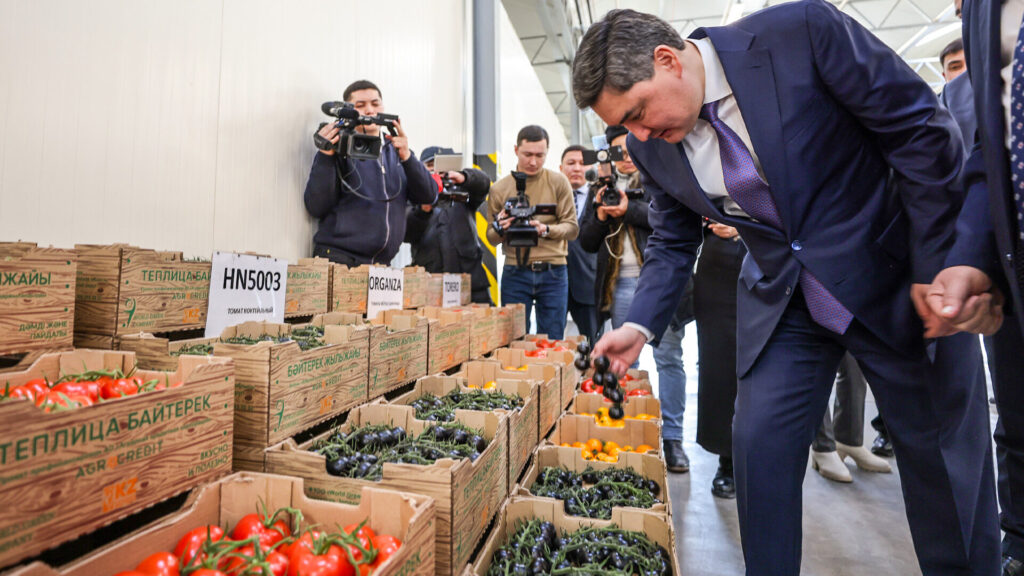
Featured photograph: an archival February 2024 government image of produce being inspected at World Green Company’s greenhouse business in West Kazakhstan. It illustrates the sector and does not document the November 2026 statistical briefing. Photo: Government of Kazakhstan / Prime Minister’s Press Service.