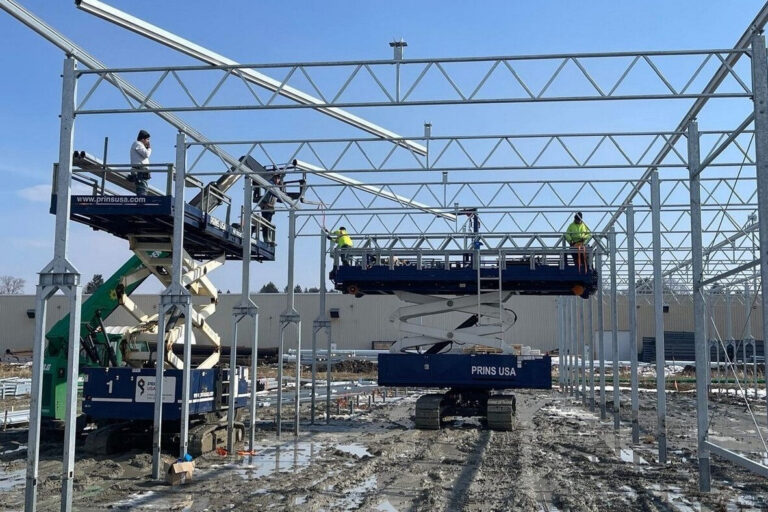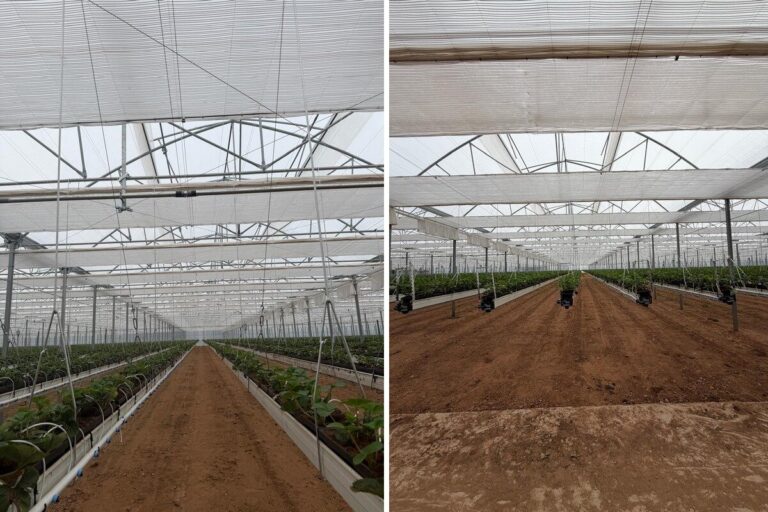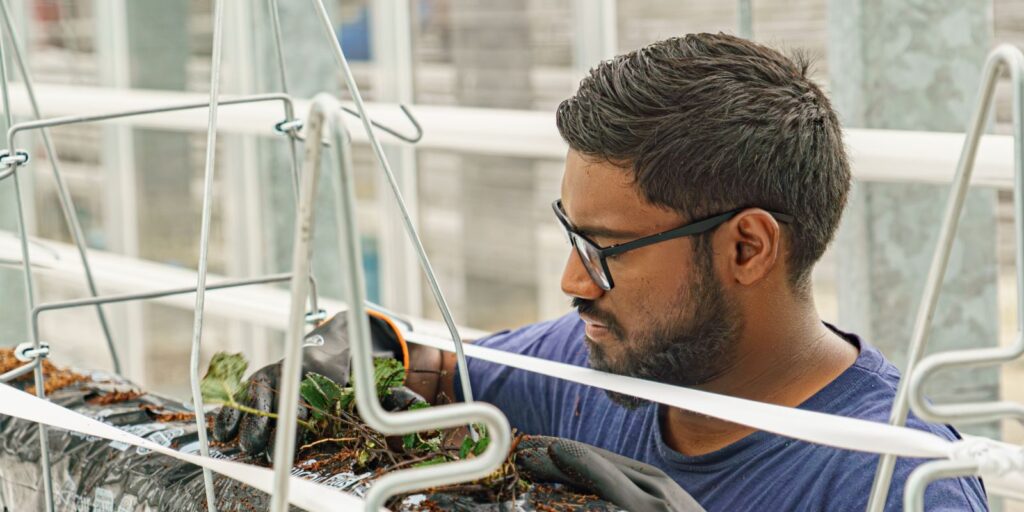
The Princess Royal officially opened the University of Lincoln’s geothermal research glasshouse at its Riseholme Campus on 10 September 2026. The completed facility is intended for research, demonstration and commercial proof-of-concept work with growers and technology businesses; it is not a commercial production greenhouse.
The University’s opening announcement says researchers and businesses will use the glasshouse to develop and test crops, growing systems and technologies. The opening also marked ten years of the Lincoln Institute for Agri-Food Technology at Riseholme.
Four controlled compartments and 18 boreholes
The glasshouse contains four independently controlled compartments of 200 m² each, allowing several trials to run at the same time. According to UK Food Valley’s facility description, environmental controls include data monitoring and CO₂ enrichment.
Heating and cooling are supplied through 18 geothermal boreholes, each 250 metres deep. UK Food Valley lists system potential of 150 kW for heating and 75 kW for cooling. Those figures describe the installed research system; they do not establish energy or cost savings for commercial growers.

Research partners and commercial testing
One programme using the facility is GASTRO, an 18-month collaboration led by NFU Energy with the University of Lincoln and Pilkington Technology Management. Two compartments use near-infrared reflective glass developed by Pilkington. The work is designed to test the combination of geothermal heating and specialist glazing, including potential effects on energy use, crop performance and emissions.
NSG Group’s account of the opening describes the glasshouse as a dedicated environment for testing technologies and growing approaches. Claims about lower costs, reduced emissions or higher yields should therefore be treated as research objectives or reported potential until trial results establish measured outcomes.
Public sources differ on project cost
The University of Lincoln stated a total project cost of £2.2 million when construction was announced, with most capital provided through a Greater Lincolnshire Local Enterprise Partnership growth fund. UK Food Valley later described the completed R&D facility as a £2.4 million glasshouse. The available public sources do not explain the £200,000 difference, so both figures require attribution.
For commercial growers and greenhouse suppliers, the immediate business relevance is access to a controlled test site where heating, glazing, crop and automation concepts can be evaluated with researchers before wider deployment. The opening confirms that the infrastructure is available; it does not by itself demonstrate commercial payback or net-zero production.
Key takeaways
- The geothermal R&D glasshouse at Riseholme was officially opened on 10 September 2026.
- It has four 200 m² compartments and 18 geothermal boreholes, each 250 metres deep.
- University and UK Food Valley sources cite different project costs: £2.2 million and £2.4 million respectively.
- The facility is for research, demonstration and proof-of-concept testing; commercial benefits remain to be validated.