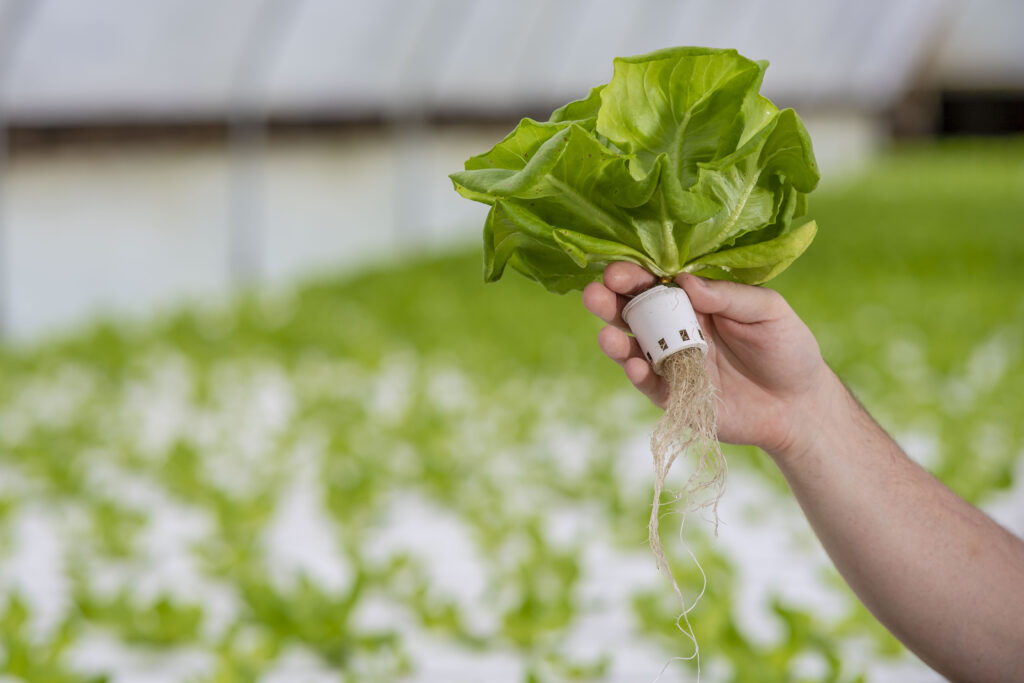
Greenhouse-grown packaged salads registered 27.4% year-on-year growth in the US retail data cited by Cox Farms, while their share of the overall packaged-salad category remained below 9%. The figures appear in the company’s State of Greenhouse Agriculture analysis, published on 12 October 2026.
The company says its analysis of NielsenIQ figures covering August 2025 to August 2026 puts greenhouse-grown products at approximately 8.7% of packaged-salad sales. Cox Farms reports that this segment generated all the category’s net growth during the period as field-grown products declined. Those numbers are the company’s interpretation of licensed retail data; HortiSignal has not independently reproduced the underlying NielsenIQ tables.
A small share of a large retail category
For producers and retailers, the combination of rapid growth and a relatively small share suggests that greenhouse-grown leafy greens remain a developing part of the packaged-salad assortment. But it does not establish the profitability of any grower or imply that every retailer or store can reproduce the reported growth rate.
Cox Farms also argues that greenhouses are gaining ground in tomatoes, cucumbers and peppers. Its leafy-greens analysis addresses a different category: packaged salads, where field-grown supply still represents the majority of measured sales.
Retailer performance and consumer familiarity
Rachel Tuszynski, Cox Farms’ senior director of sales strategy, examined how retailers with different levels of greenhouse-grown packaged-salad offerings performed before and after the 2026 cyclosporiasis outbreak. According to the company’s summary, stores with stronger greenhouse assortments generally performed better beforehand and experienced smaller category declines afterward.
That comparison is an association in the reported retailer data, not proof that greenhouse cultivation itself prevented food-safety incidents or caused shoppers to change their purchases. The research also does not establish how much of the difference reflects retailer mix, pricing or other merchandising decisions.
A separate Morning Consult survey commissioned by Cox Farms found that 59% of consumers said they were at least somewhat familiar with greenhouse-grown produce, compared with 98% of surveyed industry respondents. The contrast points to a potential communications gap between professional supply chains and shoppers, though the two groups have different roles and the surveys should not be treated as equivalent consumer samples.
What the numbers mean for growers
The company’s findings give greenhouse leafy-greens operators a retail benchmark to test against their own distribution, pricing and product mix. For buyers, the data raises questions about shelf allocation, regional demand and year-round sourcing rather than supplying a ready-made investment forecast.
Any planned capacity addition or retail assortment shift still depends on the economics of the specific region, buyer and product.
Key takeaways
- Growth: Cox Farms cites 27.4% year-on-year growth in US greenhouse-grown packaged salads from NielsenIQ data for August 2025–August 2026.
- Share: the same company analysis puts the segment at approximately 8.7% of packaged-salad sales.
- Limit: these are company-reported market findings, not independently audited sales tables or evidence that greenhouse crops eliminate food-safety risks.