

The Netherlands’ national investment and development institution Invest-NL says obtaining European authorisation for some new biological crop-protection products can take eight to ten years, creating a barrier to commercialising alternatives to conventional chemicals. The assessment appears in its Agrifood Biotech Deep Dive announcement published on 30 October 2026. It is an analysis of market conditions, not an announcement of a new EU rule or a universal statutory approval period.
The underlying Invest-NL study draws on interviews with more than 150 entrepreneurs, investors, researchers and policymakers, alongside roughly 15 years of investment data. It examines seed breeding and genetics, biological agricultural inputs, and biotechnology-based food ingredients, so its findings extend well beyond commercial greenhouses.
Long authorisation timelines affect the route to market
Invest-NL argues that European authorisation procedures, developed largely around conventional chemical products, do not always fit new biological crop-protection methods. The report says the eight-to-ten-year process can lead developers to pursue initial launches in markets including Brazil and the United States. That is the institution’s assessment, not evidence that every biological product follows the same path or that EU legislation changed in October.
For greenhouse technical managers and input suppliers, the commercial question is when a specific approved product will actually become available for a given crop and use. A technology’s performance in trials or its deployment outside the EU does not, by itself, establish authorisation for sale or application in EU greenhouse production.
An earlier commercial strawberry example, not a new launch
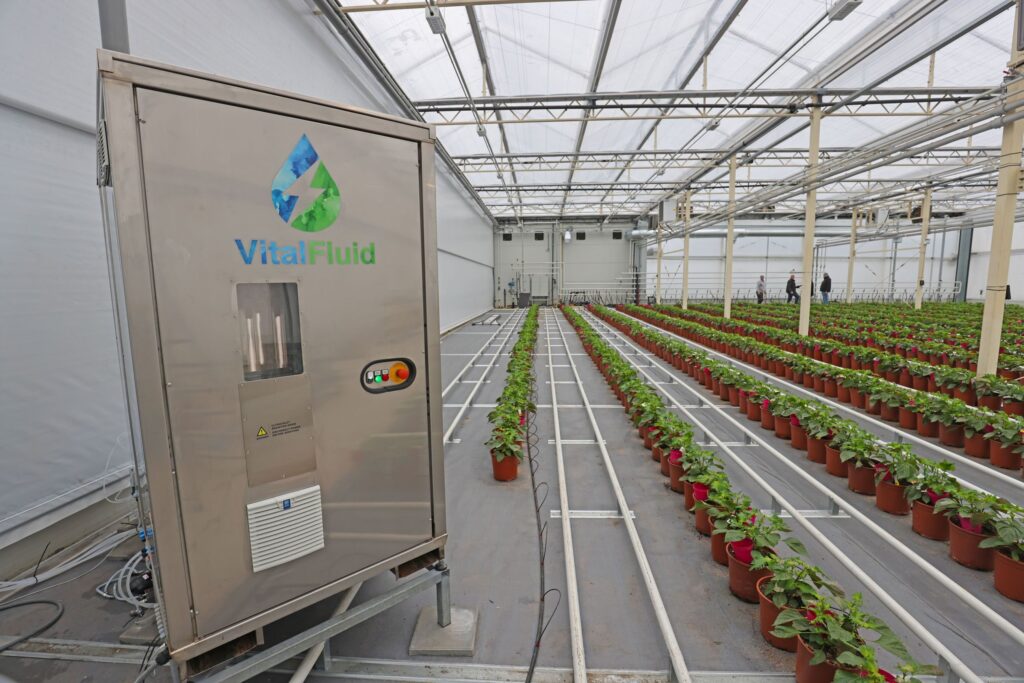
In a separate 25 August 2026 announcement, Invest-NL reported that portfolio company VitalFluid had moved its plasma-activated-water approach into commercial use with British strawberry growers on more than 100 hectares. This is relevant evidence that an alternative crop-protection technology is being deployed in commercial strawberry cultivation, but the UK installations pre-date the October study and are not a new deployment announced by the report.
Why the investment report matters
The study frames regulation, access to testing, market demand and financing as interconnected obstacles to scaling agrifood biotech companies. Its scenario of around €17 billion in additional annual Dutch revenue by 2040 applies to the broad agrifood-biotech sector, including breeding and food biotechnology. It is neither a greenhouse-sector revenue forecast nor guaranteed future turnover.
For investors and greenhouse suppliers, the report is therefore a signal about the time and capital needed to take crop-protection innovation from development to a legally accessible market. The next meaningful evidence would be product-specific authorisations, verified on-farm adoption and measurable commercial performance, rather than the publication of another aggregate forecast.
What remains unclear
The cited approval range is not broken down into an authoritative timeline for every biological category, crop or national market. The public summary also provides no greenhouse-only share of its €17 billion scenario. Neither the timing of future EU regulatory reforms nor any specific product’s approval date can be inferred from this report.
Key takeaways
- Invest-NL’s 30 October study says some biological crop-protection authorisations in Europe can take eight to ten years; no new law was announced.
- The broad €17 billion 2040 scenario concerns additional Dutch agrifood-biotech revenue, not greenhouse revenue alone.
- VitalFluid’s UK strawberry deployments are an earlier commercial example, not a new October rollout or proof of EU approval.
Featured image: Official archival photo of VitalFluid plasma-activated-water equipment inside a greenhouse. The image illustrates an earlier protected-crop application and does not depict the publication of Invest-NL’s report. Photo: VitalFluid.