

The New South Wales Government has released a Controlled Environment Horticulture Prospectus highlighting regional investment opportunities in glasshouse crops, plant propagation and automated production. The 16 November 2026 ministerial announcement identifies areas where prospective investors could assess sites and supporting infrastructure; it does not announce approval or financing for a new set of greenhouse projects.
The government highlights the North and South Coast, South East Tablelands, Illawarra and Hunter as regions with potential for further controlled-environment horticulture (CEH) activity. The prospectus is intended to help investors and operators assess opportunities in protected cropping rather than establish firm construction commitments.
Glasshouse vegetables, propagation and automation
Among the opportunities described are larger glasshouse vegetable operations, climate-controlled year-round production, commercial plant propagation and related automation. For growers, an investment decision would still require site-level analysis of energy, water, labour, logistics, planning controls and access to customers. The release does not identify contractors, secured financing or construction dates for individual new facilities.
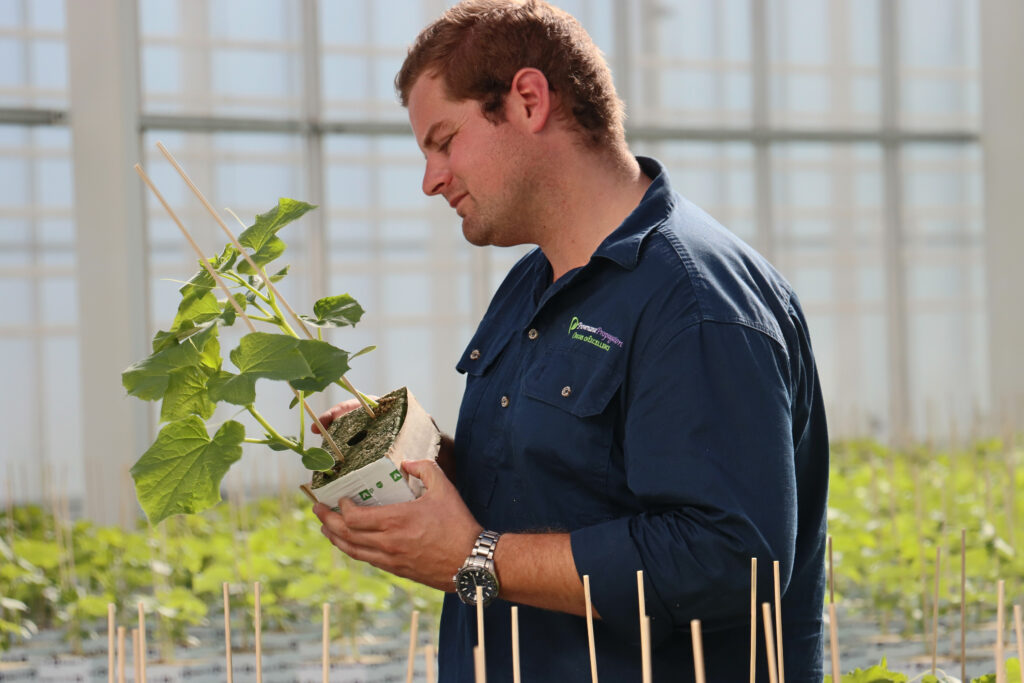
The government points to regional supply-chain advantages and existing production experience. A relevant example is Provenance Propagation, an established NSW propagation business. The announcement references an A$2.1 million grant awarded in May 2026 to support a planned 1.38-hectare expansion of propagation capacity. That grant is an earlier project example, not new funding awarded with the November prospectus.
A$2.4 billion is a national forecast, not an NSW investment budget
Two figures need particular care. The government cites a forecast of an A$2.4 billion Australian high-tech horticulture industry and an A$700 million national export market by 2030. Both are projections for Australia as a whole. Neither represents money committed to NSW greenhouse developments, an approved state project pipeline or exports already achieved.
The announcement also refers to the NSW Government’s existing A$25 million Agriculture Industries Innovation and Growth Program. This is context about prior government industry support, not an additional A$25 million appropriation created by the prospectus.
Why the prospectus matters
For greenhouse developers, equipment suppliers and investors, a government-backed location and opportunity document offers an early screening signal. It may help identify areas where demand for glasshouse structures, climate control, growing systems and propagation equipment could emerge. Whether those opportunities result in procurement depends on future private investment, site due diligence, approvals and commercially viable operating models.
What remains unclear
The announcement does not establish the cost, capacity, ownership, funding or construction timetable of any newly committed glasshouse scheme. Detailed project-level listings from the separate full prospectus have not been independently confirmed for this report, and investor uptake remains to be seen.
Key takeaways
- NSW has released an investment prospectus for controlled-environment horticulture across several regions.
- The A$2.4 billion industry and A$700 million export figures are Australian 2030 forecasts, not NSW project funding.
- The cited Provenance Propagation grant dates from May 2026; new project approvals and investments are not established by the prospectus.
Featured image: Archival view inside Provenance Propagation’s existing New South Wales greenhouse, an established business cited as a case study. The photograph does not show a newly approved project. Photo: Provenance Propagation.