

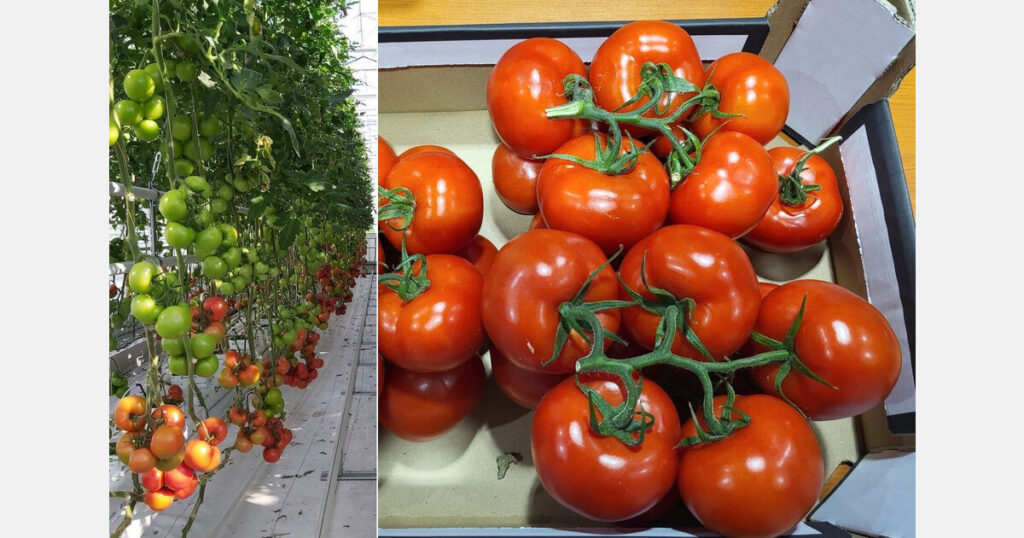
A Dutch winter tomato greenhouse trial found that a full-LED climate concept incorporating Climalux equipment used 10.5% less gas and 9.1% less electricity than a standard full-LED reference compartment. The Climalux compartment also delivered the experiment’s highest reported production, approximately 42.3 kg of tomatoes per square metre. Those figures come from the 16 November 2026 final-report announcement by the public-private Kas als Energiebron research programme.
The findings are comparative measurements from one structured trial, not verified savings or yield guarantees for commercial greenhouses outside the experiment. Importantly, the Climalux setup did not fully eliminate blotchy fruit ripening, the quality issue that prompted the study.
Four climate concepts tested side by side
Stichting HortiSearch conducted the winter 2025/26 research at HortiTech, comparing conventional high-pressure sodium (SON-T) lighting, standard full-LED, full-LED plus Caeli, and LED with Climalux. The team followed energy inputs, plant growth, water and nutrient uptake, harvest volumes and tomato colour.
Of the tested LED treatments, Climalux achieved the reported best combination of energy use and production. According to the programme partner Glastuinbouw Nederland, Caeli improved temperature uniformity and enabled screens to remain closed longer, but it did not yield additional gas savings in this experiment.
The SON-T compartment showed the most even fruit colouring, yet produced the lowest harvest and consumed the most electricity among the compared compartments. The differing outcomes illustrate the trade-off between energy reduction, marketable quality and production rather than a single clear winner on every metric.
Uneven colouring is a combined climate and crop-load problem
Researchers could not attribute blotchy ripening to one climate setting or a straightforward potassium or calcium shortage. Instead, they pointed to the interaction of temperature around the fruit, humidity and air movement, crop load, and the delivery of water and nutrients. Simply increasing water uptake did not reliably solve the colour problem.
This matters to tomato operators investing in LED lighting, ventilation and dehumidification: lower gas consumption alone is not an adequate basis for comparing climate-system options if quality losses or different crop responses offset that saving.
What remains to be tested commercially
The programme has not provided independently verified multi-site capital costs, payback periods or seasonal commercial output for these configurations. Cultivar choice, site conditions and the number of replications also matter before treating the observed percentages as a design-stage forecast for another greenhouse.
Key takeaways
- In a four-compartment Dutch research trial, the Climalux LED concept used 10.5% less gas and 9.1% less electricity than standard full-LED.
- The same compartment yielded about 42.3 kg/m², while uneven ripening remained unresolved.
- The highest quality uniformity occurred under SON-T, but at a lower yield and higher electricity use in this experiment; the economics of wider deployment are not established.