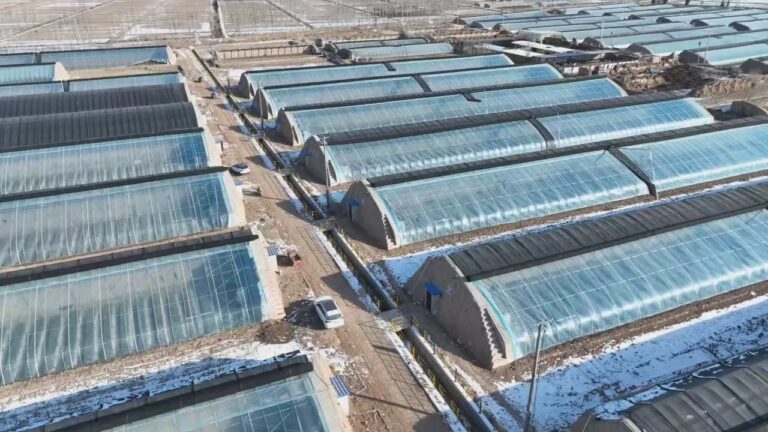


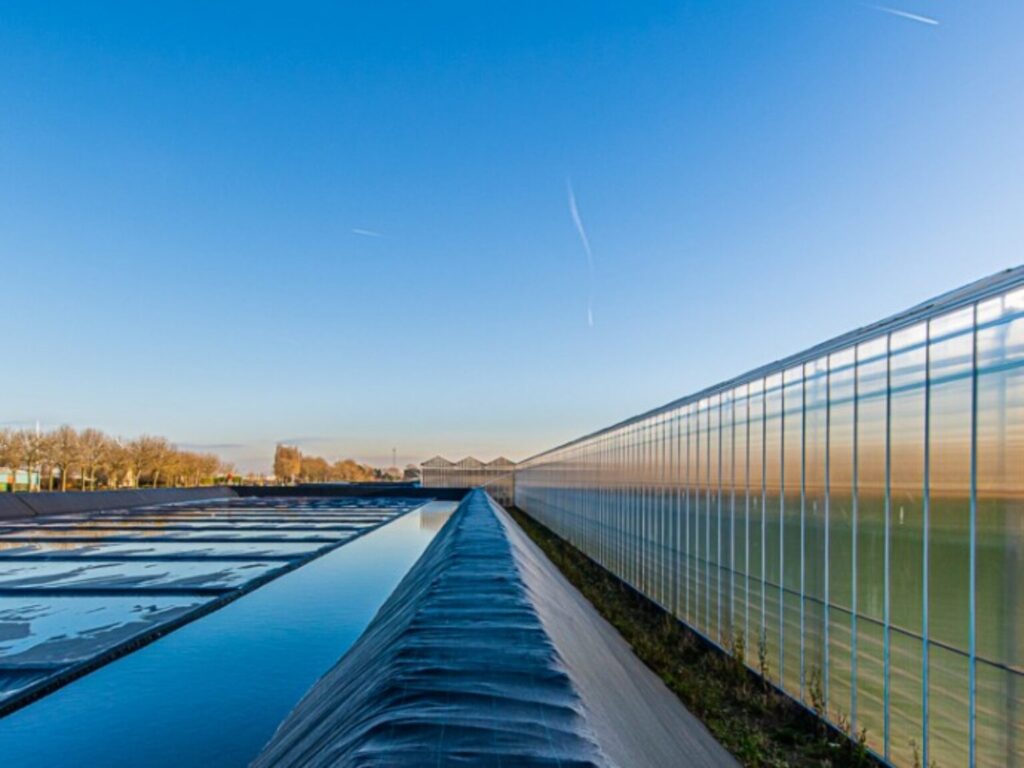
Rainlevelr, the voluntary stormwater-buffering initiative used by greenhouse businesses in the Dutch Delfland water authority area, reportedly reached 132 participating growers covering 657 hectares of greenhouse area by 29 September 2026. The latest figures were described in a project-newsletter update cited by GroentenNieuws on 18 November.
The programme makes use of unused capacity in growers’ existing rainwater basins before expected heavy rainfall. It is not the construction of a single 657-hectare facility, nor a claim that this volume of floodwater has actually been stored during a storm.
How voluntary pre-storm storage works
Under Rainlevelr, participating greenhouse operators can temporarily create space in their rainwater-storage basins when the Delfland water authority forecasts heavy rain. That empty capacity can then receive rainwater from greenhouse roofs instead of allowing all of it to enter the regional drainage system during the heaviest period.
The programme’s official website describes participation as voluntary: growers decide whether to release basin water and how much to make available, balancing stormwater management against their own irrigation needs. The public-private initiative is supported by Delfland and greenhouse-sector partners; the Glastuinbouw Waterproof project page describes technical support and reimbursement for eligible equipment.
657 hectares imply potential, not measured flood reduction
At a hypothetical 10 millimetres of available basin headroom across the reported 657 hectares, the arithmetic yields 65,700 cubic metres of potential temporary storage space. That is a conditional estimate assuming full participation and sufficient basin capacity at the relevant time, not a measurement of water released, floodwater retained or flooding prevented.
The network’s footprint has increased from an earlier official June 2026 snapshot of 130 growers and 649 hectares. The more recent 132-grower, 657-hectare figure is attributed to the project’s September update through trade reporting; the programme homepage has not yet independently updated that headline count.
Why it matters for greenhouse water planning
Greenhouse roofs rapidly channel rainfall into storage and drainage infrastructure. Making existing farm water basins available as distributed stormwater buffers offers water managers another tool during intense rain, while growers can retain access to irrigation storage outside the most critical periods. As more hectares participate, the theoretical size of that shared buffer increases without requiring an equally large new centralized reservoir.
For operators, the practical decisions remain when to lower basin levels, how much water can safely be released, and what automated connections are needed. The network-wide area alone cannot answer those operational questions.
What remains unclear
The update does not establish how much water was actually buffered during individual 2026 storms or which share of the reported area was prepared on any particular warning. Performance therefore should be evaluated against event-specific basin levels and measured runoff, rather than the theoretical maximum alone.
Key takeaways
- Rainlevelr’s reported September 2026 network comprises 132 growers and 657 hectares of greenhouse area in Delfland.
- The frequently cited 65,700 m³ is a conditional 10 mm headroom calculation, not observed floodwater retention.
- Growers opt in to pre-storm basin management and decide whether and how much water to release.