

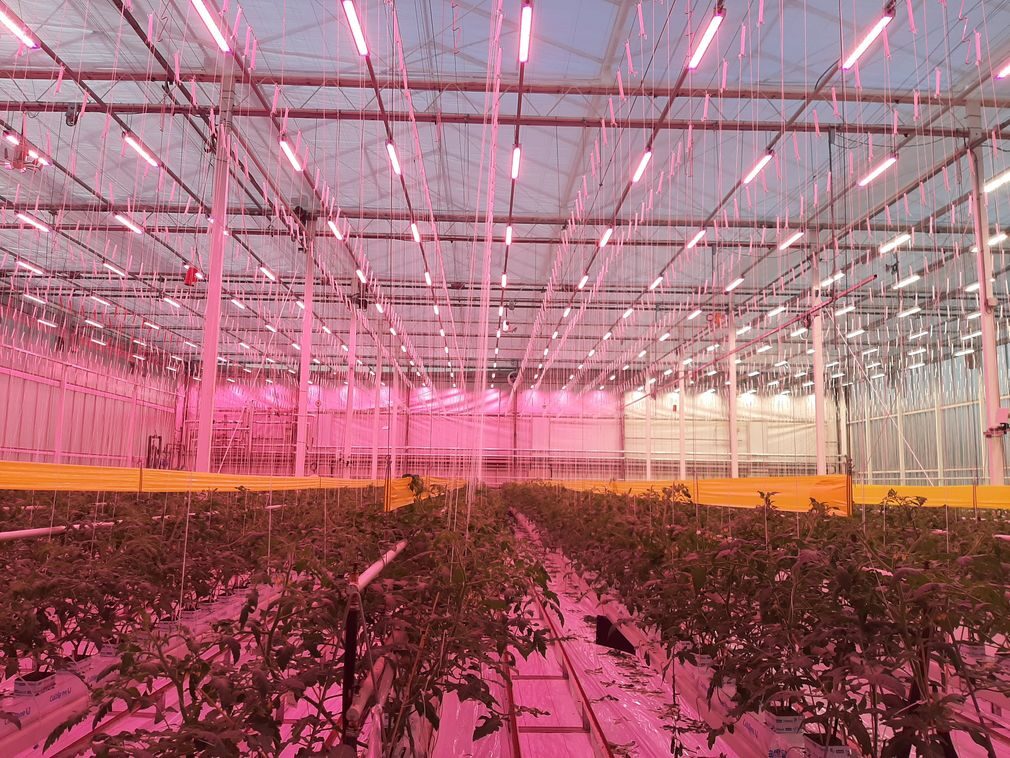
Wageningen University & Research (WUR) and Delphy Improvement Centre are running two greenhouse tomato research programmes to test whether far-red light, lower LED intensity and dynamic dimming can improve the crop’s use of artificial light. The experiments began in September 2026 and are scheduled to continue through April 2027; they are trials, not proven energy-saving results.
The work addresses a commercial question for illuminated tomato operators: how to maintain fruit production and quality while limiting electricity input when additional LED light does not necessarily translate into proportional yield gains.
Far-red comparison: 325 PAR versus 295 PAR plus 30 far-red
In the 29 October announcement by Kas als Energiebron, WUR researcher Anja Dieleman and Delphy researcher Brigit den Bakker describe a comparison between a reference programme of 325 µmol/m²/s photosynthetically active radiation (PAR) and a treatment using 295 µmol/m²/s PAR plus 30 µmol/m²/s far-red.
The far-red component is switched according to incoming sunlight and replaced with PAR light at the stated trigger. The design tests whether changing the spectrum and timing can alter how efficiently tomato plants use supplied light; it does not establish an increase in light-use efficiency in advance.
At WUR the comparison covers Macxize and Fortitude tomatoes. At Delphy it includes Macxize and a further comparison of standard nutrition against a strategy designed to encourage potassium uptake. These factors are part of the trial design, rather than demonstrated production benefits.
Masterplan Licht tests dimming and lower intensity
The parallel Masterplan Licht project compares a higher-intensity reference with lower-intensity treatments, far-red supplementation and lighting scheduled around daylight. Its Delphy component includes two greenhouse compartments of approximately 250 m² each, comparing peak-period dimming against a more energy-focused red-light strategy.
Delphy’s project description places dynamic LED control within its wider 2024–2027 research programme. Researchers assess the distribution of light across the day, crop development, production and fruit quality, rather than treating electricity consumption as the only outcome.
Why it matters for commercial greenhouse lighting
Growers with LED installations face both power-price exposure and a crop-performance constraint: light savings are economically useful only if they do not undermine yield or quality. The tests could inform how future lighting recipes are set, particularly where electricity prices and natural light vary over the day.
What remains unclear
The announcement contains treatment designs but no final comparative results for these September 2026–April 2027 trials. It would be premature to claim a specific percentage saving, yield increase or payback period. Independent results and full measurements are expected only after sufficient trial data are available.
Key takeaways
- WUR and Delphy are testing far-red LED spectra, reduced intensities and smarter dimming in tomatoes.
- One design compares 325 PAR with 295 PAR plus 30 far-red µmol/m²/s.
- Performance and economic gains remain hypotheses until the experiments conclude.