

Greenhouse growers in Almería, Spain, had forcibly removed 5.8% of the province’s pepper-growing area by the end of October 2026 because of Thrips parvispinus, according to a 11 November assessment from the Andalusian agriculture department. The figure relates to the opening months of the 2026/27 growing campaign, not a final season-wide harvest or production-loss estimate.
The department compared that early-season removal with 3.5% of pepper area uprooted between October and December in the preceding 2025/26 campaign. Those measurement windows are different lengths. They show the severity of this season’s early damage, but should not be presented as equivalent full-season loss rates or as a precise year-on-year increase for identical periods.
Spain’s ministry opposes renewed pesticide requests
In an 11 November request, Andalusia asked Spain’s Ministry of Agriculture to grant exceptional-use authorisations for products containing spirotetramat and spinetoram. The regional government says a previous request for spirotetramat was formally refused on 22 October. The renewed application is not an authorisation.
On 13 November, the national ministry publicly pushed back against the prospect of spirotetramat use. In a ministry statement reported by Europa Press, it described the substance as prohibited, warned against raising false expectations among growers and cited possible endocrine-disruption concerns. The ministry also argued that chemical control alone had been insufficient. This was a clear public position opposing renewed use, but the reported statement is not itself independently verified proof of a new formal administrative refusal of the 11 November applications.
Andalusia says biological pest management is used on approximately 97% of its protected pepper area, but considers currently authorised controls insufficient against the invasive thrips. The national ministry instead emphasised combining crop-residue management, registered biological-control organisms and existing authorised products. The administrations disagree on the adequacy of available tools; neither position establishes that the two requested substances are approved or commercially proven against the outbreak.
Almería’s pepper sector faces an early capacity loss
During a 13 November visit to a greenhouse in Berja, Andalusian agriculture councillor Ramón Fernández-Pacheco rounded the uprooted-area estimate to approximately 6%. That is a rounded reference to the same early-October assessment, not a separate new survey.
He said Almería’s pepper sector cultivates around 13,500 hectares and produces close to one million tonnes annually. These are regional annual-scale figures, not tonnage already lost to the pest during 2026/27. The authority also reported widespread thrips presence in pepper plantings that remain in production, with damage varying by site.
Why this matters to greenhouse operators and buyers
Forced removal of young pepper crops affects productive greenhouse area before a normal season can be completed. Growers must weigh the cost and timing of replanting and preventive control; packers and buyers have a reason to monitor whether the problem results in measurable supply disruptions. The reported uprooted-area share alone cannot establish future market prices or a corresponding percentage drop in saleable pepper tonnage.
For growers, biological-control suppliers and crop-protection providers, Madrid’s public opposition makes exceptional spirotetramat use an uncertain planning assumption, irrespective of whether the renewed application receives a separate formal decision. The Andalusian April 2026 plant-health resolution already established compulsory and recommended measures to reduce the spread of the pest. Operators should follow current legally authorised treatments and integrated-management guidance rather than treat the requested chemicals as available tools.
What remains unclear
The regional figures do not establish a final full-season area loss, marketable production lost or the eventual effect on export supply. The ministry’s 13 November public stance, as reported, does not by itself establish a separately documented formal decision on the 11 November spirotetramat and spinetoram requests. Updated comparable crop and marketing data, together with any written administrative determination, remain the next verifiable signals.
Key takeaways
- Andalusia reports that 5.8% of Almería greenhouse pepper area was uprooted by the end of October in the 2026/27 campaign.
- The earlier 3.5% figure covers October–December 2025 and is not a matched-period comparison.
- Andalusia reports an earlier spirotetramat refusal on 22 October; Spain’s ministry publicly opposed its renewed use on 13 November. Neither requested substance is newly authorised on the evidence cited.
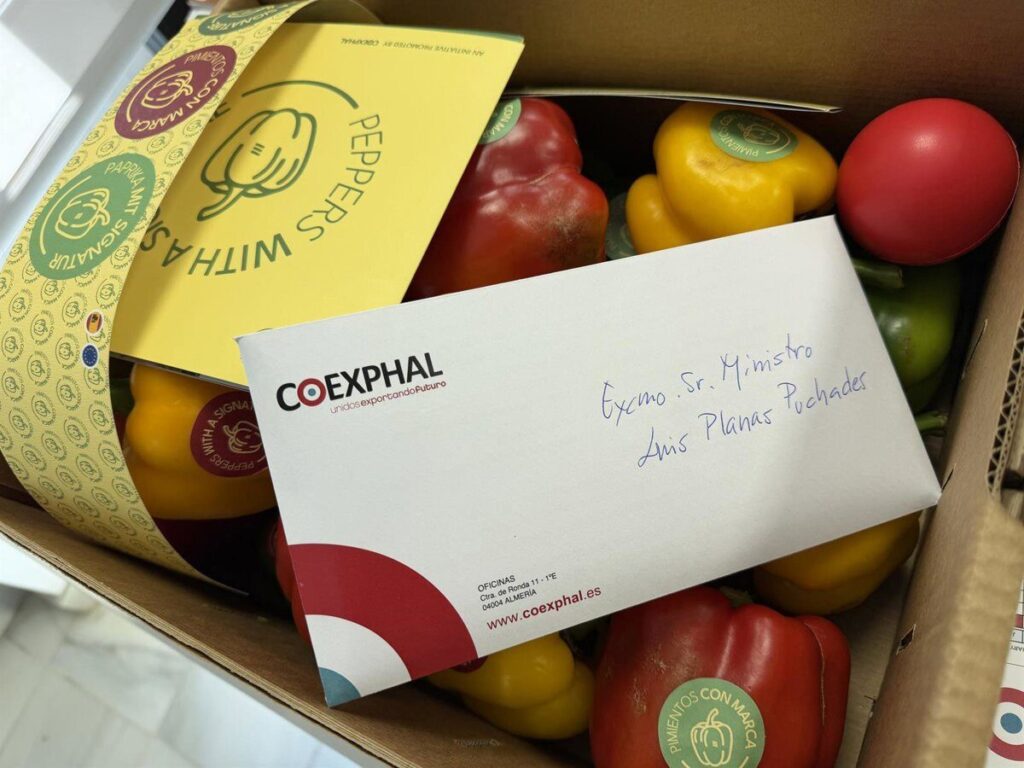
Featured photo: A box of peppers damaged by thrips that growers’ association COEXPHAL sent to Spain’s agriculture minister in November 2026. It illustrates the pest issue, not the government’s acreage assessment. Photo: COEXPHAL.