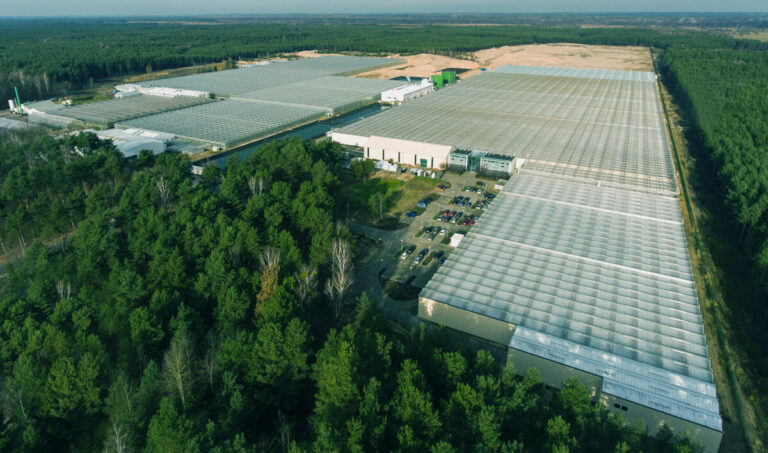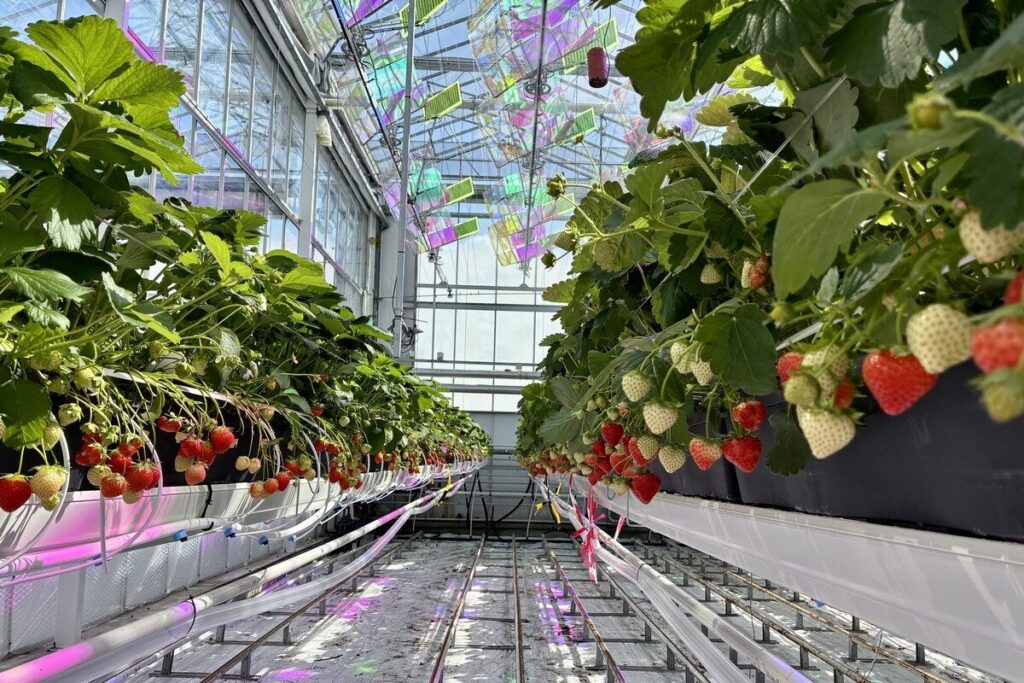
Voltiris and Genson Group have formally opened a one-hectare spectral-filtering solar installation above a producing strawberry crop in Someren, the Netherlands. Almost 2,000 Voltiris modules now hang beneath the greenhouse roof, according to the supplier’s account of the 8 October 2026 opening. The system is installed and the crop remains in production, but seasonal electricity-generation and fruit-performance results have not yet been reported.
More than 60 growers, partners and industry visitors attended the opening, Voltiris said. The company reports that the installation took four weeks while strawberry growing continued in the greenhouse. That is a commercial deployment milestone, distinct from the May 2026 project announcement and from the results of earlier research trials.
Solar modules that filter greenhouse light
The technology places wavelength-selective modules above the crop. Photosynthetically active light is intended to reach the plants, while part of the near-infrared radiation carrying heat is redirected to photovoltaic cells for on-site electricity production. The supplier’s objective is to combine cooling and renewable power with continued strawberry production under glass.
Genson is a substantial Dutch soft-fruit grower supplying retail channels through customers including Bakker Barendrecht. The original May project announcement describes why this deployment is intended for commercial-scale validation: strawberry crops can suffer heat stress during bright periods, while growers also face rising energy and electrification costs.
What the opening does — and does not — prove
The installation demonstrates that the hardware can be fitted across a working hectare of strawberry greenhouse without a reported interruption of cultivation. It does not yet independently demonstrate a specific annual energy output, cooling benefit, return on investment or yield increase at Genson’s site.
Voltiris has publicised encouraging results from earlier controlled strawberry trials, including premium-fruit quality and temperature improvements. Those trial outcomes should not be extrapolated automatically to this site’s full production season. The company expects the first operating results from the Genson system after winter, when performance measurements can be assessed over a more meaningful period.
Commercial relevance for growers
For greenhouse operators considering agrivoltaics, this project moves the discussion beyond a planned pilot to an installed system in a named grower’s active production glasshouse. The key business questions remain the electricity actually produced, shading and crop-quality effects, maintenance demands and project economics under local energy prices. Neither rated electrical capacity nor the project’s capital cost was disclosed in the opening announcement.
Key takeaways
- Genson’s Someren strawberry glasshouse now hosts nearly 2,000 Voltiris modules across one hectare.
- The four-week installation reportedly proceeded while commercial cultivation continued.
- The site is operating, but independently assessed crop, power and financial results are still pending.
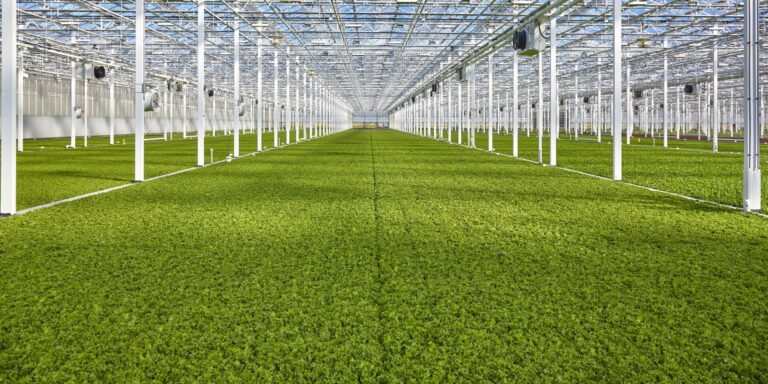
Featured image: strawberry plants below spectral-filtering modules, from Voltiris’s Genson project announcement. Photo: Voltiris. The image is not presented as proof of measured performance.