

Andalusia’s agriculture department says Spain’s central government refused a request to allow temporary use of the active substance spirotetramat against Thrips parvispinus in greenhouse pepper crops. The refusal was disclosed in a regional statement dated 27 October 2026; the statement does not specify the date or formal instrument of Madrid’s decision.
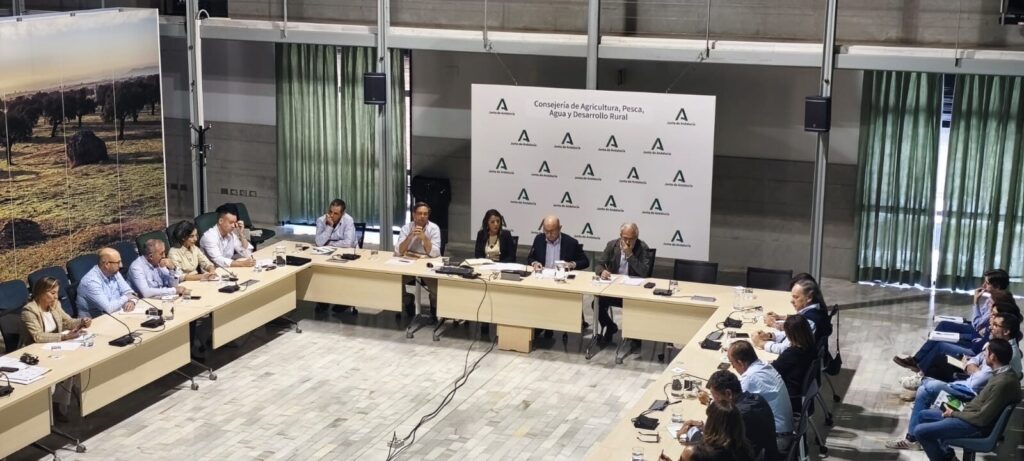
Photo: Junta de Andalucía. The regional plant-health committee meeting discussed the response to the pest; the photograph does not show the central government’s authorisation decision.
The Junta said it had written to Spain’s Ministry of Agriculture, Fisheries and Food at the request of producers in Almería, seeking an exceptional, temporary authorisation. It reported that the request was denied and called for the ministry to participate in finding workable crop-protection solutions. This is the regional authority’s account of the response, not a separately published ministry decision.
An exceptional-use request, not a new blanket ban
The issue arose at a meeting of Andalusia’s plant-health committee, which includes regional officials and major farming organisations. Participants raised the limited availability of plant-protection tools and the use of exceptional authorisations. The committee argued that an exceptionally permitted active substance could help address the pest in protected pepper production. That assessment should not be read as independently measured treatment efficacy.
The October disclosure concerns one requested temporary use of spirotetramat. It does not announce a new general prohibition on the substance, a blanket change to Spanish pesticide law or permission for growers to apply it.
Existing greenhouse pest measures remain in place
Andalusia had already declared the pest and established control measures in a resolution dated 10 April 2026. For specified greenhouse crops in Almería and Granada, the resolution makes crop-removal precautions mandatory, including greenhouse closure, trapping and appropriate handling of crop residues. Separate biological-control protocols for pepper crops are recommended, rather than a substitute for the compulsory measures.
Regional technical guidance notes that T. parvispinus can shelter in curled leaves and young fruit, making control difficult, and that its populations commonly peak in October and November. The Junta’s biological-control guidance calls for a preventive programme adapted by each operation’s crop-protection specialist.
What growers and suppliers should watch
The refusal leaves Almería pepper operators and input suppliers without the exceptional use requested by regional producers, according to the Junta. Planning therefore needs to distinguish existing registered control options and mandatory pest-prevention measures from any future authorisation proposal. The 27 October statement does not disclose the ministry’s reasoning, decision date or whether a revised application will follow.
Key takeaways
- Andalusia reported on 27 October that Spain had denied a request for temporary spirotetramat use against Thrips parvispinus in greenhouse peppers.
- The disclosure does not establish a new general ban or authorise use of the substance.
- Existing mandatory greenhouse hygiene and crop-removal measures continue to apply while the sector seeks additional control tools.