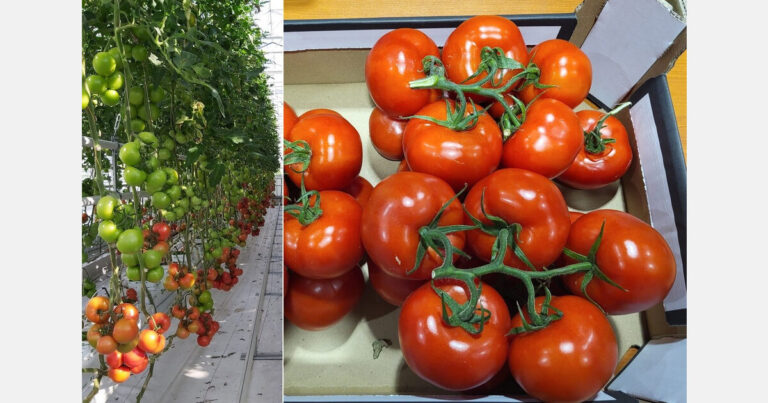


At its 10-hectare tomato-growing site in Harmelen, the Netherlands, Noordhuys is using IUNU’s LUNA camera-and-sensor platform to track crop development and inform harvest forecasts. The system is operating as a 2026 pilot; it is not yet running autonomously at this site, according to firsthand interviews published by Dutch trade magazine Vakblad Onder Glas on 12 November.
The trial began in March 2026 with IUNU and seed breeder Enza Zaden involved. Noordhuys says the data became usable in June after an initial calibration period. That timing matters: its growers expect the more consequential test of data-led cultivation decisions to come in the next crop cycle, when comparable information can be collected from the beginning.
Six cameras monitor 22 greenhouse paths four days a week
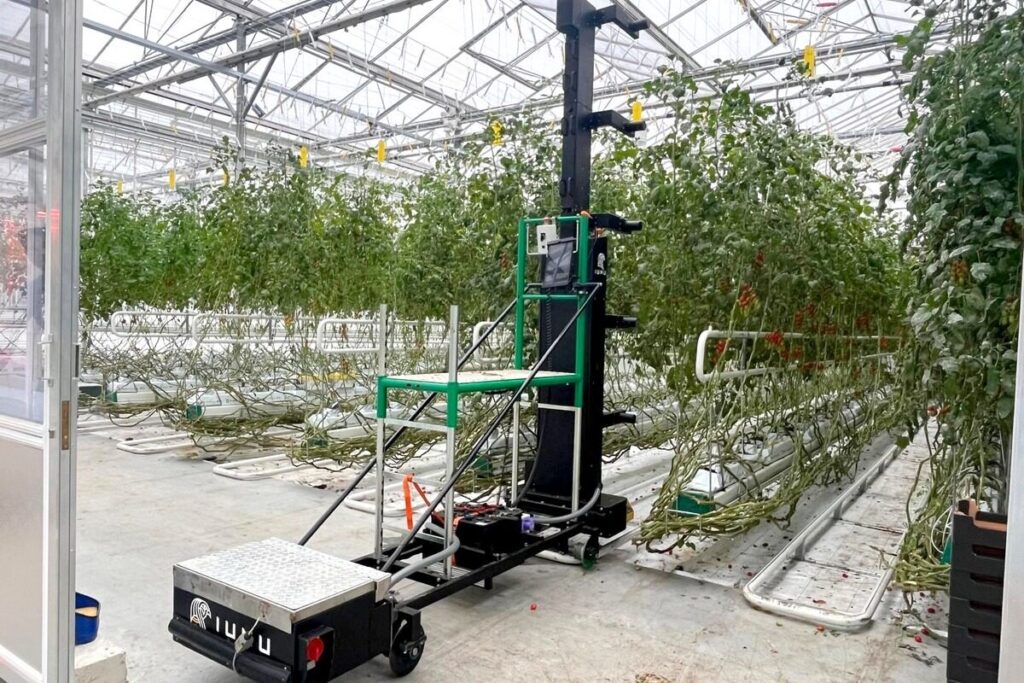
The configuration at Harmelen uses a mast on a pipe-rail trolley, equipped with six cameras and two climate sensors. It travels through 22 paths on four days each week, collecting images of plants and measurements of the microclimate. Camera images are analysed with computer vision to count and characterise plant features, including tomato fruit, trusses, leaves and growing tips.
The 10 hectares describe the greenhouse site; the report does not establish that the trolley scans every plant across the entire area. For now, someone accompanies and directs the trolley rather than leaving it to navigate independently.
Grower Jan-Willem Bolle and facility specialist Wouter van Noord described using the dashboard to compare crop development between rows and compartments. The measurements help staff assess growth rate, flowering height, plant-head thickness and fruit development over time, rather than relying solely on occasional manual checks. Noordhuys also uses the information for harvest projections shared with its sales team.
In one example reported by the growers, an unusual growth pattern led staff to investigate a local difference in carbon-dioxide supply. They say the early warning helped prevent a potential production loss. This is an operator-reported operational benefit, not a published independent measurement of yield improvement or return on investment.
From monitoring towards crop steering
For commercial greenhouse operators, the distinction between collecting data and acting on it is significant. Repeated plant-level observations can help identify changes that are easy to overlook in a manual sample, but the financial case still depends on reliable measurements, workflow integration, staff time and outcomes over a complete growing cycle.
Enza Zaden is participating in the pilot, including observation of its Fortitude tomato variety. In a separate official announcement dated 22 July 2026, the seed company confirmed a strategic investment in IUNU to deepen their existing collaboration on crop imaging and cultivation insights. That investment provides business context but does not independently validate results at Noordhuys.
Noordhuys hopes to extend monitoring to roughly 40 paths in 2027 and adopt a fully autonomous trolley. IUNU has also introduced a natural-language question-and-answer feature for examining the collected crop data. Further applications, including biological pest monitoring and assessment of crop-work quality, are being considered; they should not be confused with established functions or documented commercial outcomes at the Harmelen site.
What remains unclear
The growers have not published independently audited figures for forecasting accuracy, yield gains, labour savings, installation cost or payback. The planned expansion and autonomous operation are intentions, not completed deployments. Results from an entire subsequent crop cycle will be more informative than early observations from a system whose first months were spent calibrating.
Key takeaways
- Noordhuys is actively testing IUNU LUNA in a Dutch tomato greenhouse, collecting images and climate readings across 22 paths on four days each week.
- Harvest forecasting and earlier detection of unusual crop development are current operator-reported uses, without independently quantified financial benefits.
- Coverage of around 40 paths and autonomous operation remain 2027 plans; the business case will depend on verified performance over time.
Featured photograph: IUNU LUNA monitoring equipment at the Proof research and demonstration greenhouse, photographed in 2024. This is an archival illustration of the technology, not a photograph of Noordhuys’ Harmelen facility or its 2026 pilot. Photo: HortiDaily.