

Commercial greenhouse growers in the Netherlands face a new recordkeeping deadline for plant-protection products: from 1 January 2027, professional users must maintain treatment records in a machine-readable digital format. In guidance published on 18 November 2026, the Dutch Ministry of Agriculture, Fisheries, Food Security and Nature (LVVN) confirmed that the Netherlands Food and Consumer Product Safety Authority (NVWA) will check compliance from that date.
The rule covers professional use across agriculture and horticulture, including permanent greenhouses and other protected-cropping facilities. It implements existing European rules, particularly Commission Implementing Regulation (EU) 2023/564; the November ministry notice is a compliance reminder, not the adoption of a new pesticide law.
Greenhouse-specific treatment information
The ministry’s requirements cover the type of treatment, plant-protection product name and authorisation number, treatment date, applied dose, precise location, treated area or quantity, and crop identity using the relevant EPPO code. Where the product label requires them, the treatment time and crop growth stage, expressed with a BBCH code, also need to be recorded.
For applications in permanent greenhouses, the official requirements table specifies a greenhouse or storage-room identifier and the volume or floor area treated, where applicable. These details distinguish protected cultivation from open-field records. Greenhouse operators therefore need to check whether their current spray logs identify the specific compartment or location as well as the product and dose.
Thirty days to digitise; ten working days to provide records
Growers may choose their own recording system; the ministry does not mandate a particular software supplier. Records must be converted to a machine-readable electronic form within 30 days of each application. The guidance gives examples including a spreadsheet, word-processing document or searchable PDF, provided software can identify and extract the information.
When competent authorities request the records, growers must supply the digital information within ten working days. The EU registration requirement does not impose a general duty to disclose those records directly to other private parties. The NVWA says it will inspect the registration arrangements from January 2027; incomplete compliance may lead to enforcement measures or sanctions.
A 2025 amendment to the EU rules gave Member States the option not to require electronic conversion of records for pesticide applications made before 1 January 2027. That transition provision should not be confused with an exemption from the new Dutch compliance date.
What protected-crop businesses should check now
The near-term task is an operational audit rather than a new pesticide-approval decision. Growers should confirm that existing logbooks or crop-management software capture greenhouse location identifiers, product authorisation numbers, quantities and crop codes, and can produce retrievable electronic records on request. Glastuinbouw Nederland also flagged the January obligation to protected-horticulture operators on 19 November.
For greenhouse-management software providers, the deadline creates a concrete customer compliance requirement, but the published guidance does not certify any particular product. Operators should evaluate their own recording and export workflows against the official table before the effective date.
Key takeaways
- 1 January 2027: Dutch professional growers, including permanent-greenhouse operators, must use machine-readable digital pesticide-use records; NVWA compliance checks begin.
- 30 calendar days: the normal deadline to convert application records into electronic format; ten working days: the period to provide records on an official request.
- Growers can choose their recording system, but greenhouse-specific location and treatment data must be retrievable. The ministry’s November notice explains existing EU requirements rather than introducing a new law.
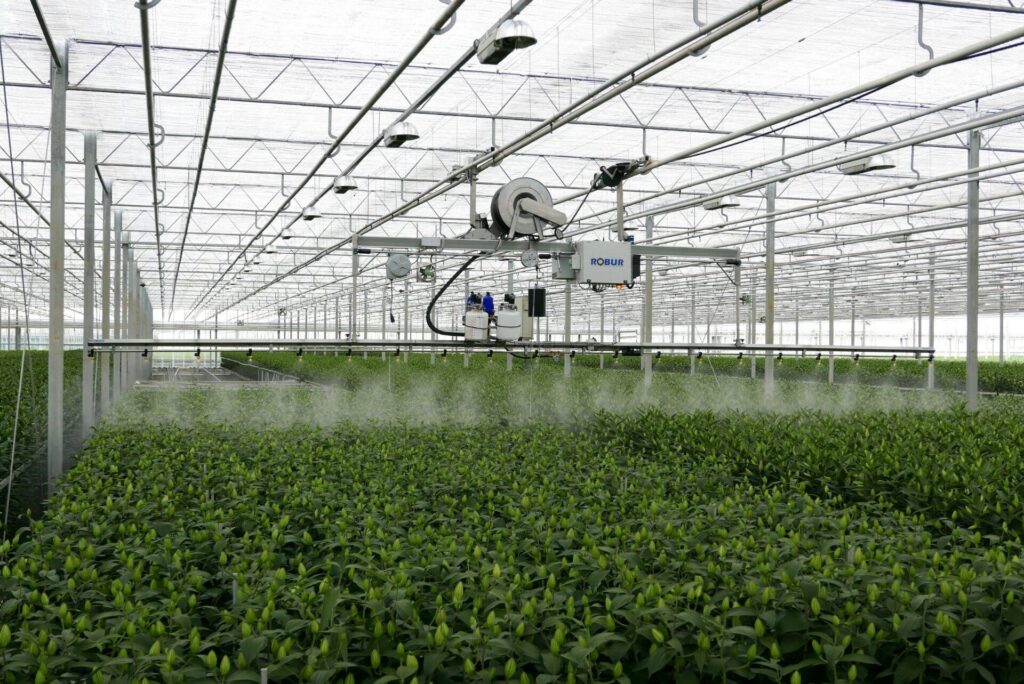
Featured photograph: automated crop spraying in a Dutch lily greenhouse, shown as an illustration of greenhouse plant-protection operations, not an NVWA inspection or the 2027 compliance rollout. Photo: Robur Holland.