

Positive expectations for the Dutch floriculture sector have fallen even as growers report wider adoption of sustainable practices. In Royal FloraHolland’s newly released 2026 Floriculture Trend Report, 54% of surveyed growers viewed the sector’s future positively, compared with 70% in the earlier 2025 survey. The cooperative presented the latest findings at Trade Fair Aalsmeer on 4 November, according to on-site reporting by Nieuwe Oogst.
Research company Markteffect surveyed 205 floriculture growers and buyers for the report. The confidence figure concerns respondents’ views of the industry’s prospects, not an independent measure of turnover, profitability or the outlook for every greenhouse crop. The results cover flowers and ornamental plants, a substantial part of commercial protected horticulture.
Sustainability sentiment moves in the opposite direction
62% of growers expressed a positive view of making the sector more sustainable, up from 49% in the earlier comparison, according to contemporaneous coverage of Royal FloraHolland’s findings. Some 88% said they had made changes to grow more sustainably. These are reported practices, not independently measured reductions in water use, energy consumption or chemical inputs.
Commercial willingness to pay has also shifted in the survey: 31% of buyer respondents said they would pay more for a more sustainable assortment, up from 25% previously, as Nieuwe Oogst reported. Expressed willingness is not evidence that wholesale prices have increased or that those premiums have been realised.
Water supply is a concrete operating concern
66% of grower respondents described their businesses as largely or fully self-sufficient in water, while roughly three-quarters reported collecting rainwater and about half reusing drainage water. Yet only 51% said they monitor water quality. These findings make the gap between water storage, reuse and measurement particularly relevant for greenhouse operators assessing resilience and potential equipment needs.
Royal FloraHolland links the concern to changing water-quality requirements and periods of drought. Growers’ responses point to water monitoring and treatment as issues for future operational planning, but the survey does not establish a corresponding volume of new equipment orders or investment commitments. The cooperative also reported that 23% of growers use AI for financial administration and forecasting, a separate indication of changing management practices.
What the figures mean — and what remains unknown
For floriculture suppliers, investors and greenhouse managers, the report describes a sector seeking operational improvements while feeling less optimistic about its business environment. The immediate decisions are likely to be site-specific: water reliability, input costs, monitoring needs and whether buyers will pay enough to support new measures. None of the survey percentages alone establishes a national investment forecast.
The full 2026 questionnaire and detailed subgroup weighting were not independently available for this article. Grower-only and buyer-only percentages therefore should not be applied to all 205 respondents interchangeably, nor generalized to vegetable growers or audited environmental performance.
Key takeaways
- Positive expectations among surveyed floriculture growers fell to 54%, versus 70% in an earlier survey.
- Sustainability sentiment rose to 62%, and 88% of growers report making changes, without independent impact measurements.
- Water monitoring remains a practical gap: 51% report tracking water quality even as many collect and reuse water.
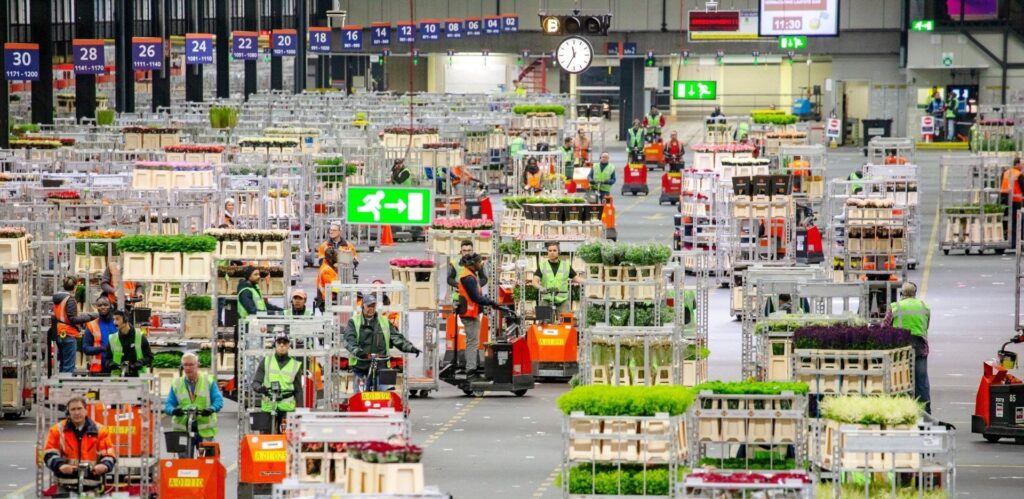
Featured image: Archival official photograph of flower-handling and auction logistics at Royal FloraHolland. It does not depict the November 2026 report presentation. Photo: Royal FloraHolland.